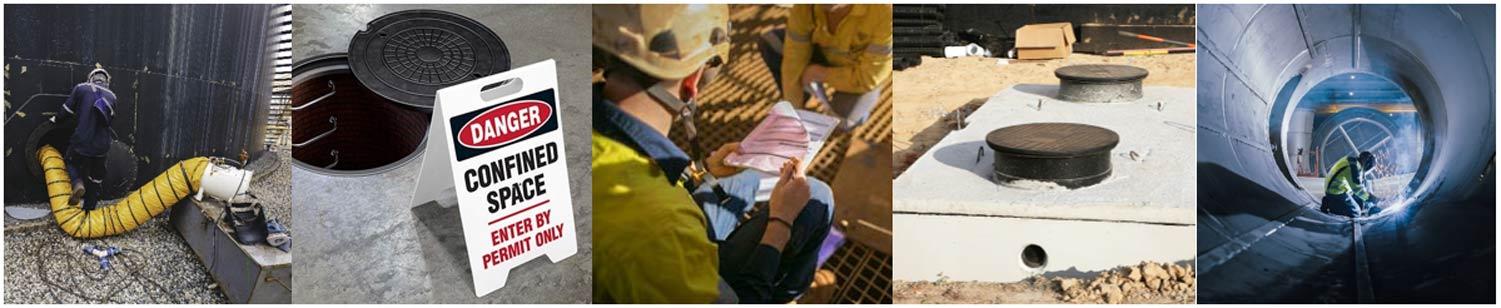
Federal and MA State OSHA confined space entry standards for general industry (1910.146) and construction (1926 Subpart AA) require privately-owned businesses, non-profit organizations, and affected governmental organizations in Massachusetts to implement a comprehensive confined space entry program for their employees who are involved in confined space entry work. A key element of that program is providing confined space training for all affected workers involved in confined space work. This includes all confined space entrants, attendants, and entry supervisors at general industry and construction work sites with permit-required confined spaces, as well as the competent person at construction sites.
Have a highly qualified instructor conduct an on site confined space training class for your group of employees in Massachusetts. The confined space training can be based on the OSHA 1910.146 general industry standards for entering permit-required confined spaces, or the newer OSHA 1926 Subpart AA confined spaces for construction standards. This service is available to all employers located in MA.
Also, trainees have the option to take one of our comprehensive online confined space training courses, available for the construction industry and for general industry. Course options include training for entrants and attendants, entry supervisors, and the competent person at construction sites. Basic “How to Identify Permit Spaces” courses for construction sites and general industry sites also available. Sign up one student, or use our free Learner Management System (LMS) to purchase multiple courses / assign to students / track their progress. Course immediately available upon registration. Students can train at their own pace, logging in and out at any time, even from different computers / devices. Print your personalized training certificate upon successful completion of your course.

ON-SITE CONFINED SPACE ENTRY TRAINING CLASS
- Training class conducted for your group in Massachusetts
- Class based on 1926 construction standards or 1910 general industry standards for confined space entry
- Training covers confined space entrants, attendants, entry supervisors, and the competent person

ONLINE CONFINED SPACE TRAINING COURSES
- Log in and out, train at your pace. Print your cert when done
- Courses based on either 1926 construction or 1910 general industry confined space entry standards
- Courses for entrants and attendants, entry supervisors and the competent person, business owners and managers
How to Identify Permit Required Confined Spaces
Want to learn how to determine if you even have a permit-required confined space at your work site? You can learn how to make that determination by taking one of the following “How to” courses online.
How to Identify Permit Required Confined Spaces at General Industry Work Sites
- Based on OSHA 1910.146 standards
- Instant access
- Train at your own pace
How to Identify Permit Required Confined Spaces at Construction Sites
- Based on OSHA 1926 Subpart AA standards
- Instant access
- Train at your own pace
Confined Space Training Options Available to Massachusetts Employers
We offer on-site confined space training classes conducted by a highly qualified instructor for groups of employees at facilities in Massachusetts. The training can be based on OSHA 1910.146 general industry standards for entering permit-required confined spaces or the OSHA 1926 Subpart AA confined spaces for construction standards. We also offer comprehensive online confined space training courses available for the construction industry and for general industry, with course options including training for entrants and attendants, entry supervisors, and the competent person at construction sites.
How Online Confined Space Training Works
Students can sign up individually or use our free Learner Management System to purchase multiple courses, assign them to students, and track their progress. Courses are immediately available upon registration.
When Confined Space Training Is Required for Construction
For construction, 29 CFR 1926.1207 requires employers to provide training at no cost to employees and ensure they possess the understanding, knowledge, and skills necessary for safe performance of duties assigned under the standard. Training must be provided before the employee is first assigned duties under the standard, before there is a change in assigned duties, whenever there is a change in permit space entry operations that presents a hazard about which an employee has not previously been trained, and whenever there is reason to believe that previous training was not effective. The employer must maintain training records containing each employee's name, the name of the trainers, and the dates of training.
Frequently Asked Questions:
Who regulates confined space entry requirements for employers in Massachusetts?
Private sector employers and their workers in Massachusetts are covered by federal OSHA. Massachusetts operates an OSHA-approved State Plan that covers only state and local government workers. Federal OSHA confined space entry standards for general industry (29 CFR 1910.146) and construction (29 CFR 1926 Subpart AA) require privately-owned businesses, non-profit organizations, and affected governmental organizations in Massachusetts to implement a comprehensive confined space entry program.
What does the online confined space training course include?
All courses include the basics, such as information needed to understand the OSHA definition of a confined space and the criteria that can make a space permit-required. Training for actual entrants, attendants, entry supervisors, and the competent person are incorporated into the specific courses for these personnel. There are module quizzes and a final exam with each course. Students can train at their own pace, logging in and out at any time, even from different computers or devices, and print their personalized training certificate upon successful completion.
What must confined space training cover for entrants?
For construction, 29 CFR 1926.1207 requires that training establish employee proficiency in the duties required and introduce new or revised procedures as necessary for compliance. Entrants must be trained on the hazards they may face, signs and symptoms and effects of exposure to those hazards, the proper use of PPE, gas monitors, communication devices, and rescue equipment, procedures for communicating with the attendant, and the importance of exiting the space immediately if a hazard arises or if they're told to evacuate.