Confined Space Entry Training

OSHA Confined Space Entry Training and Certification

  • ON-SITE Confined Space Entry Training Classes
    • Confined Space Training for General Industry
    • Confined Space Entry Training for Construction
  • ONLINE Confined Space Entry Training Courses
  • Confined Space Training Blog
  • Contact

Confined Space Engulfment Hazards

August 22, 2023 by Curtis Chambers 2 Comments

Confined space engulfment hazards

Blog Post #14 – In this post to The Confined Space Training Blog, we will examine another reason a confined space identified at your workplace should be classified as a permit-required confined space. And that is when a confined space contains a liquid or material that could potentially engulf the entrant.

What is Engulfment in a Confined Space?

The Federal OSHA definition of engulfment can be found in 1910.146 paragraph B, and includes confined spaces where the entrant could suddenly be surrounded or captured by liquid, trapped inside the space, and drown in the liquid.
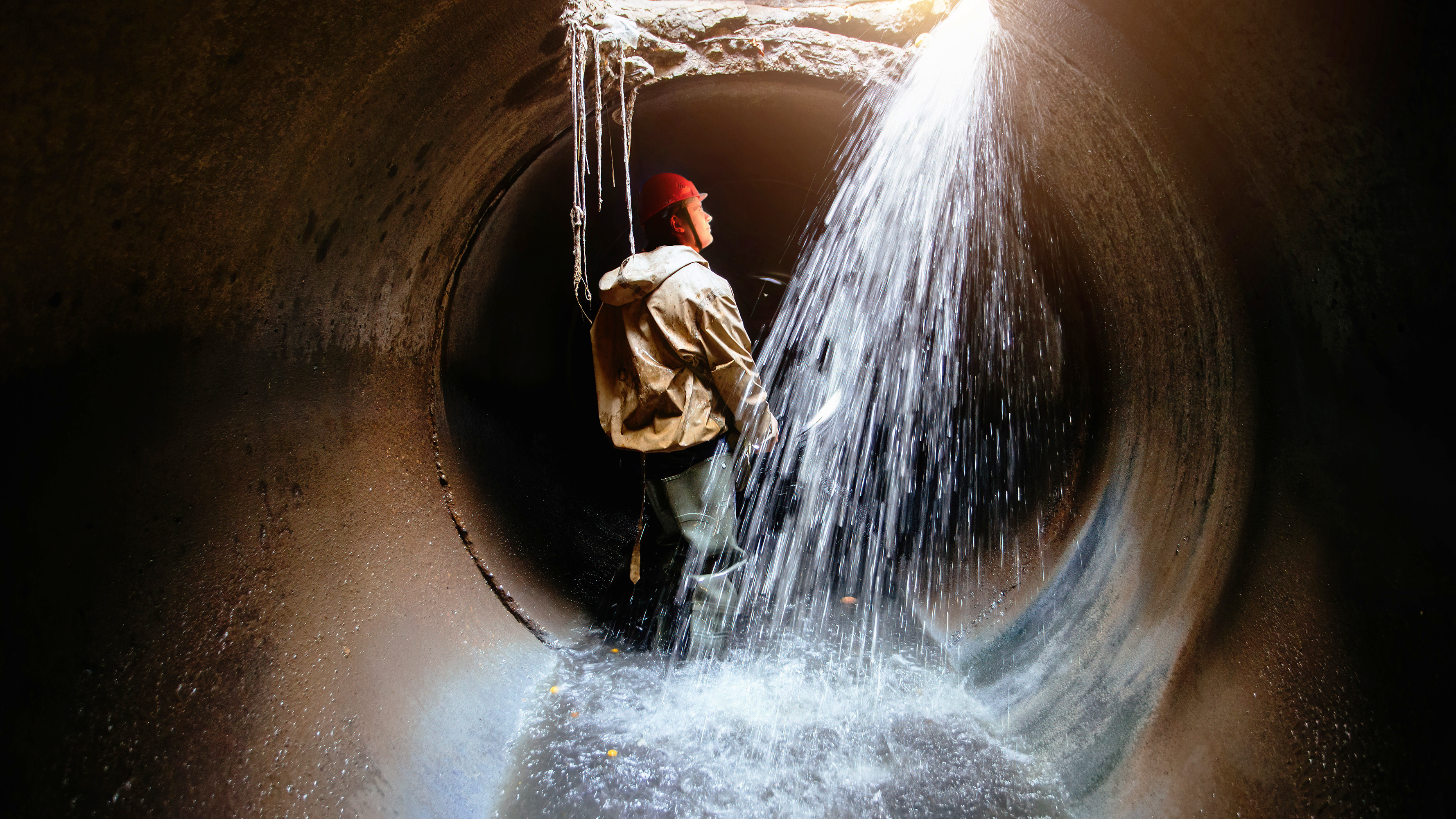
Engulfment in liquid sewer confined space

Engulfment by liquid could occur in sanitary and storm sewers, as well as in any pipelines, utility vaults, or process tanks that could suddenly be filled with liquid.

One other form of engulfment is possible whenever a confined space contains a finely divided solid material, such as pellets, chips, grains, granules, dusts, or powders, that can be aspirated by the entrant once engulfed. his could cause death by filling or plugging the respiratory system. In other cases, the material surrounding the trapped entrant can exert enough force on the body to cause death by strangulation, constriction, or crushing. Regardless of the mode of engulfment, these are all a gruesome way to die!

Confined spaces that contain potential engulfment hazards include, but are not limited to, grain elevators and storage bins, as well as other confined spaces that contain materials such as flour, sawdust, powdered cement, or finely pelletized materials.

How Does Engulfment in a Solid Material Occur Inside a Confined Space?

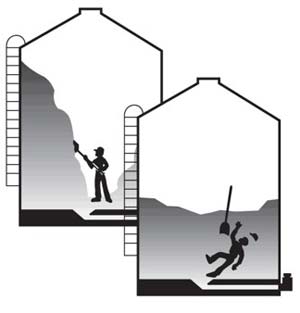
The illustration below demonstrates how a finely divided material can appear from the top to fill a confined space when, in actuality, a hollow void area could develop beneath the surface. This condition is often referred to as “bridging.”
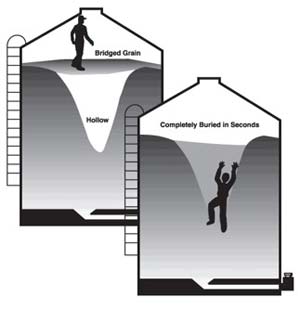
Engulfment - Material bridging inside a confined space

The weight of the employee can cause the bridged material to collapse, and the worker can fall into the void area and be covered by the flowing material.

In this second illustration, the employee is engulfed when the material, which has clung to the side of the wall inside the confined space, collapses and covers the employee.
OSHA definition of engulfment in a confined space

Recap of Engulfment in a Confined Space

So in review, any confined space containing, or with the reasonable potential to be quickly filled with, a liquid or finely divided material that can engulf the entrant must be treated as a permit-required confined space.

Please provide your feedback and/or questions about this blog post on engulfment hazards in confined spaces in the comments section below. Then be sure to come back later and read our next blog post (#15), where we will discuss additional hazards that can trigger the permit-requirements in confined spaces.

And as always, I ask that you take a moment to spread the word about our confined space training blog by sharing a link to this post with others in your network so they can benefit from this information. Thanks – Curtis

Filed Under: Permit Required Confined Spaces Tagged With: 1910.146, 1926 subpart AA, engulfment

Definition of a Hazardous Atmosphere – Immediately Dangerous to Life or Health (IDLH)

July 11, 2023 by Curtis Chambers 2 Comments

IDLH

Blog Post #13 – In this post to The Confined Space Training Blog, we will examine the fifth and final category listed in the Federal OSHA definition for a hazardous atmosphere in a confined space, which is an atmosphere that is Immediately Dangerous to Life or Health, or IDLH.

What Does IDLH Mean?

IDLH stands for “Immediately dangerous to life or health”. This term is defined in the Federal OSHA confined space standards as “any condition that would interfere with an individual’s ability to escape unaided from a permit space and that poses a threat to life, or that would cause irreversible adverse health effects.” OSHA goes on to qualify their definition of IDLH by adding that certain substances, like hydrogen fluoride gas and cadmium vapor, can cause immediate, temporary effects that may not require medical intervention, even if they are severe. However, after exposure to high levels of these substances when the affected individual may appear to have fully recovered from the initial symptoms, these diminished effects are followed by a sudden and potentially fatal collapse within twelve to seventy-two hours of over-exposure. Therefore, materials with these characteristics present in hazardous amounts are also categorized as immediately hazardous to life or health (IDLH) by OSHA.

For further context, the term IDLH is also found in the Federal OSHA respiratory protection standard at 1910.134, where it is defined as “an oxygen deficient atmosphere, or, any atmosphere of unknown composition.” And in the Federal OSHA HazWoper standard (1910.120), IDLH is defined as “an atmospheric concentration of any toxic, corrosive or asphyxiant substance that poses an immediate threat to life or would cause irreversible or delayed adverse health effects or would interfere with an individual’s ability to escape from a dangerous atmosphere.”

NIOSH IDLH Values

Federal OSHA does not quantify IDLH levels or concentrations of specific airborne toxic substances in 1910 Subpart Z like they do for their permissible exposure limits (or PELs). However, other agencies and groups do list IDLH values for specific chemicals; the primary one in the USA being NIOSH, aka the National Institute for Occupational Safety and Health. NIOSH defines IDLH as an atmospheric concentration of a specific airborne substance “that poses a threat of exposure to airborne contaminants when that exposure is likely to cause death or immediate or delayed permanent adverse health effects or prevent escape from such an environment.”

NIOSH considered two factors while determining their IDLH limits. Firstly, they wanted to ensure workers would be able to exit the area where they came into contact with dangerous chemicals without enduring lasting harm to their health. And secondly, they wanted workers to be able to escape without experiencing severe eye or respiratory tract irritation (or other conditions) that could hinder their ability to evacuate.

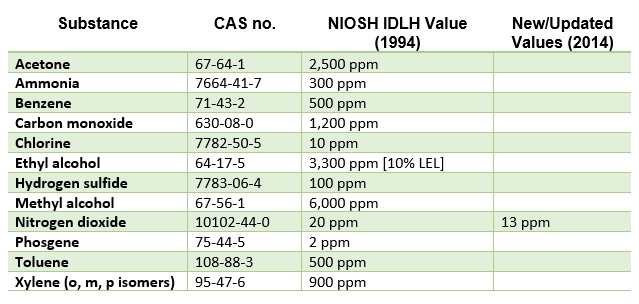
NIOSH currently lists IDLH values for more than 380 substances. Here is a table displaying a dozen common substances and their assigned NIOSH IDLH values as originally assigned in 1994, and as updated, where applicable, in 2016.

IDLH NIOSH

Many of these substances listed above have a Federal OSHA PEL based on an 8-hour time-weighted average (TWA), but do not have a short-term exposure limit (STEL), which is based on a 15-minute average exposure, or a ceiling limit (C), which is based on instantaneous exposure. Therefore, in some cases brief exposures to certain substances (Carbon Monoxide being one of them) may not exceed the OSHA PEL, but could exceed the NIOSH IDLH value.

Other Types of IDLH Atmospheres

Last but not least, some of the other types of “hazardous atmospheres” discussed in the preceding blog posts could also be considered to be IDLH if present in high enough quantities. For example, an atmosphere that is oxygen deficient would certainly be classified as IDLH, as would an atmosphere containing a flammable gas or vapor at levels exceeding 10% of its LEL (or LFL); see Ethyl alcohol on the NIOSH list for one such example. And in certain cases, it could be possible that an atmosphere that is extremely hot (from steam or other heat sources) could incapacitate a person should super-heated air damage their lungs or trachea when inhaled.

Review of OSHA’s Definition of a Hazardous Atmosphere

In review, a confined space containing a hazardous atmosphere, or with a reasonable potential for a hazardous atmosphere to develop, is considered a permit-required confined space. And OSHA lists five different categories of potentially hazardous atmospheres inside a confined space.

The first one is when any flammable gas, vapor, or mist is present in a quantity greater than 10% of its LFL; Next is when airborne combustible dust is present at quantity greater than, or equal to, its LFL; A hazardous atmosphere also exists when the atmospheric oxygen concentration drops below 19.5%, or rises above 23.5%; as well as when a toxic substance is present in a quantity greater than it’s permissible exposure limit, or PEL. Finally, the atmosphere in a confined space is classified as hazardous whenever it is determined to be immediately dangerous to life or health, or IDLH.

Please provide your feedback and/or questions about this blog post on IDLH atmospheres, or about any of the other type(s) of hazardous atmospheres, in the comments section below. Then be sure to come back later and read our next blog post (#14), where we will discuss engulfment hazards in confined spaces. And as always, I ask that you take a moment to spread the word about our confined space training blog by sharing a link to this post with others in your network so they can benefit from this information. Thanks – Curtis
Filed Under: Permit Required Confined Spaces Tagged With: IDLH

Definition of a Hazardous Atmosphere – Toxic Substance Exceeding the OSHA PEL

June 2, 2023 by Curtis Chambers 2 Comments

OSHA Hazardous Atmosphere Toxic PEL

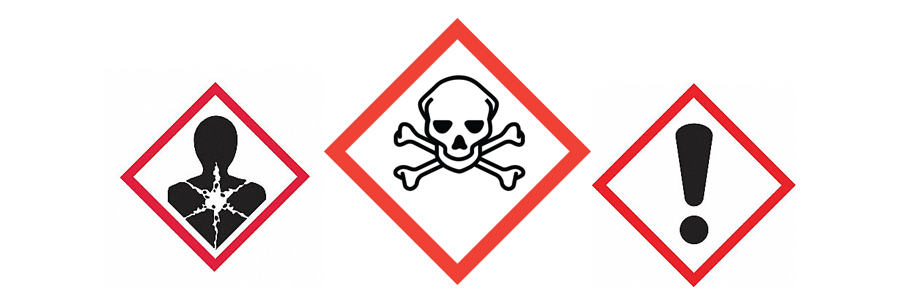
Blog Post #12 – In this post to The Confined Space Training Blog, we will examine the fourth category listed in the Federal OSHA definition for a hazardous atmosphere, which is an atmosphere that contains any toxic substance present in quantity greater than its permissible exposure limit, or PEL.

Before moving on, make certain to pay close attention to an important footnote to this definition in the OSHA definition section for this standard. OSHA states that this category of hazardous atmosphere only applies “if the topic substance can cause death, incapacitation, impairment in ability to self-rescue, injury, or acute illness due to its health effects.”

For example, exposure to ammonia in the atmosphere at levels above its PEL for an extended period of time would cause the entrant to experience burning eyes and throat, difficulty breathing, and make it extremely difficult to function normally; exposure to extremely high levels could even lead to death. This condition would meet the definition of a hazardous toxic atmosphere in the confined space standards. However, exposure to silica or asbestos at levels over their respective PELs, although harmful in the long term, would typically not cause any immediate reaction. So, overexposure to those particular substances would not meet the definition of a hazardous atmosphere as defined in the OSHA confined space standard (although normal protective measures required by other OSHA standards would still be applicable).

What are OSHA PELs?

The term PEL represents the maximum exposure level for a particular contaminant that an employee may be exposed to at work, averaged over a specified period of time, without suffering negative health effects or needing to take protective measures such as use of a respirator. PELs for various contaminants are established by Federal OSHA and are listed in different parts of the OSHA code of federal regulations.

Part 1910 lists the PELs that apply to general industry worksites. Part 1926 for construction and Part 1915 for shipyards also have PELs, and some of those may differ from those listed in Part 1910. In addition, many states operate their own OSHA approved state program. Some have adopted the federal OSHA PELs, but a few states have established their own PELs, some which are lower than federal OSHA’s.

In addition to the mandatory OSHA PELs, there are some other voluntary limits that you may hear mentioned. For example, The American Conference of Governmental Industrial Hygienists, or ACGIH, has developed threshold limit values, or TLVs, for many substances. And The National Institutes of Occupational Safety and Health, or NIOSH, developed recommended exposure limits, or RELs, for many substances. These are based on more recent research than the OSHA PELs in many cases, and may be set lower (or higher) than the OSHA PEL for some substances.  Employers MAY voluntarily choose to utilize these lower limits instead. Also, these voluntary limits are often utilized when OSHA has not established a mandatory PEL for a specific substance.

The permissible exposure limits for most individual substances in gas and vapor form are presented as parts per million, or PPM, which is a way to measure very small quantities of toxic air contaminants at a molecular level. The more toxic the substance, the lower the PEL. For example, the 1910 General Industry permissible exposure limit for ammonia is 50 ppm.

To help visualize the concept of substances being measured in parts per million, or ppm, consider this; if a contaminant evenly dispersed in a space makes up one half of the total atmosphere in that space, it would be measured at 500,000 ppm. If the substance made up 5% of the total atmosphere, it would be measured at 50,000 ppm, and if a substance made up 1% of the total atmosphere, it would measure at 10,000 ppm. A substance making up one tenth of 1% of the total atmosphere would measure at 1,000 ppm, and a substance making up one one-hundred-thousandth of a percent would be measured at 10 ppm. And a few substances are so toxic, their permissible exposure limits are actually measured in parts per billion, or PPB.      

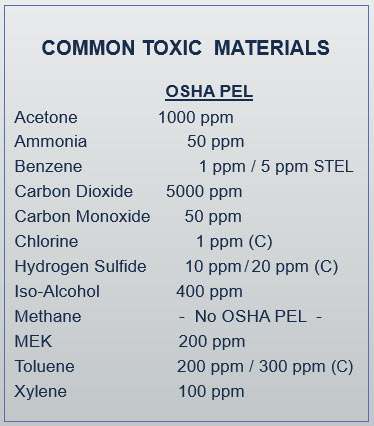
The table below shows the federal OSHA PELs for a few common toxic substances found in some confined spaces.

OSHA Permissible Exposure Limits Confined Spaces

Different Types of OSHA PELs

Unless noted otherwise, OSHA permissible exposure limits are based on an “eight-hour time-weighted average,” also known as TWA.  8-hour TWA means that the employee exposure to the substance is averaged over an eight-hour work shift. For example, the OSHA PEL for acetone is listed as 1,000 ppm, which is averaged over 8 hours.

Some permissible exposure limits are appended with a designation of ST or STEL, which stands for “short term exposure limit.” This is an exposure limit that is averaged over a shorter, 15-minute time period, as opposed to the 8-hour period. For example, the PELs for benzene are listed as 1 ppm based on an 8-hour TWA, but a STEL of only 5 ppm.

A few other substances are marked with the letter C, which stands for ceiling limit. For example, the PEL for chlorine is a ceiling limit of only 1 ppm. This limit is instantly reached any time the employee is exposed to the substance at the level specified.

It is important for employers to identify the toxic substances that employees may be exposed to when entering confined spaces. It is also important for entrants and attendants to know about the modes of exposure, as well as the signs and symptoms of overexposure, to toxic substances. This information can usually be obtained from each substance’s safety data sheet, or SDS.

Toxic Atmospheres in Confined Spaces

So, in review, a hazardous atmosphere exists where a toxic substance is present in a quantity greater than its permissible exposure limit (PEL). This can occur in confined spaces such as, but not limited to, tanks and vessels where a toxic product has been stored or is being utilized, and in underground spaces, such as crawl spaces, utility vaults and sewers, where a hazardous substance such as hydrogen sulfide (H2S) can migrate into the space.

Also, toxic gases such as CO can be created by equipment such as generators, chop saws, and compactors that are powered by internal combustion engines. As a reminder, if there is a hazardous substance for which OSHA has not established a PEL, refer to that substance’s safety data sheet, or SDS, for exposure recommendations and guidelines.

In our next blog post (#13), we will examine the fifth and final criteria of a hazardous atmosphere that could be present inside of a confined space (any other IDLH atmosphere). In the meantime, please provide your feedback to this blog post about toxic atmospheres in the comments section below.

And as always, I hope you will take a moment to spread the word about our confined space training blog by sharing a link to this post with others in your network so they can benefit from this information. Thanks – Curtis
Filed Under: Permit Required Confined Spaces Tagged With: 1910.146, 1926 subpart AA, ceiling limit, hazardous atmosphere, OSHA permit required confined space entry standard, PEL, STEL, toxic, toxicity

Definition of a Hazardous Atmosphere – Oxygen Deficiency or Enrichment

April 28, 2023 by Curtis Chambers Leave a Comment

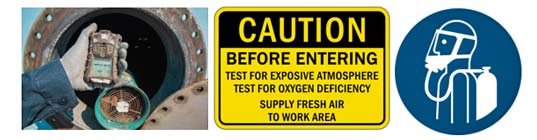
Oxygen deficient atmosphere

Blog Post #11 – In this post to The Confined Space Training Blog, we will examine the third category listed in the Federal OSHA definition for a hazardous atmosphere, which is an atmospheric concentration of oxygen less than 19.5%, or greater than 23.5%.

Atmospheric Composition

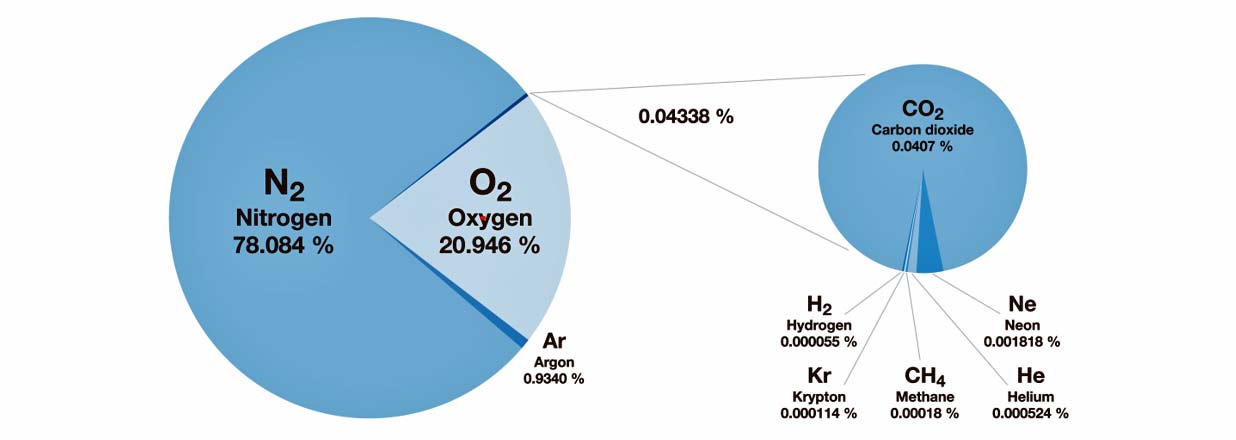
Oxygen is critical to support human life. However, under normal conditions, over 78 percent of the air we breathe is actually comprised of nitrogen, which is an inert gas. And oxygen, commonly referred to as O2, makes up approximately 20.9% of the atmosphere.

OSHA hazardous atmosphere oxygen enrichment or oxygen deficiency

If oxygen levels were to fluctuate slightly, there would most likely be no ill effects on a healthy person. However, a greater decrease or increase in oxygen levels could prove to be harmful; even deadly.

So, OSHA sets the threshold for an oxygen deficient atmosphere at anything less than 19.5% oxygen, and the threshold for an oxygen enriched atmosphere is reached when the O2 levels exceed 23.5%.

What Can Cause an Oxygen Deficient Atmosphere?

One way an atmosphere may become oxygen deficient is if the oxygen gets consumed. One cause of oxygen consumption is flames. A flame must have adequate oxygen to burn. As the flame burns, the oxygen is consumed. That is why the flame on a small candle will slowly extinguish if you cover the candle with a glass, preventing it from getting more oxygen. Similarly, a poorly ventilated confined space in which there has been a flash fire, or where flame producing equipment is present, could become oxygen deficient.

Oxidation is another cause of oxygen deficiency. When metal rusts, that process, called oxidation, consumes oxygen. So does the process of concrete curing. Therefore, confined spaces with a rusty interior surface, or confined spaces formed with freshly poured concrete, could also become oxygen deficient over time.

An oxygen deficient atmosphere can also be created by displacement of the atmosphere, which can occur if another gas fills up the confined space and supplants the oxygen. This happens inside sewers and underground vaults quite often, when naturally-occurring Methane gas seeps into the space. Another way for this to occur is when another gas is accidentally introduced into a confined space through a leaking pipe, cracked hose, or partially open valve. For example, a leaking hose containing Argon or other inert shield gases used during some welding processes is one potential cause of oxygen displacement inside a confined space.

In relatively rare cases, an inert gas is introduced into a confined space purposely, to displace oxygen. This can help prevent materials inside the space from oxidizing. Purging the space with an inert gas can also prevent a highly-flammable atmosphere from igniting during entry operations.

Another way oxygen can be displaced is when certain chemicals are mixed inside of a confined space. For example, mixing vinegar and baking soda creates a bubbly concoction that releases carbon dioxide gas when the bubbles burst. When these or other reactive chemicals are present in great enough quantities, the resulting chemical reactions could release gases that eventually build up to levels high enough to displace oxygen in the confined space.

A less common cause of oxygen deficiency is adsorption. Some manufacturing processes utilize activated charcoal filters to capture unwanted gases. Sometimes a portion of the oxygen adheres to the activated charcoal, which can result in lower oxygen levels in the air.

Effects of Oxygen Deficiency

The effects of oxygen deficiency on a person vary as the level of oxygen drops. In reality, most people in good health would probably not perceive much, if any, ill effect when oxygen levels drop to 19.5%, the threshold of oxygen deficiency. However, when oxygen levels drop to around 16%, the entrant may start suffering the symptoms of hypoxia, where they find it harder to breathe and start to become nauseous and drowsy. When oxygen levels drop to 12% or less, the entrant will become unconscious, and when oxygen levels drop to 6% or less, brain cells begin to deteriorate, and death occurs through asphyxiation.

What is an Oxygen Enriched Atmosphere?

When oxygen levels inside a confined space exceed 23.5% by volume, an oxygen enriched atmosphere is present. One common reason this occurs is because pure oxygen is introduced into the space, either accidentally or on purpose.

Leaking hoses, pipes, or valves on equipment that utilize pure oxygen can result in an oxygen enriched atmosphere inside a confined space. That is why the OSHA welding and cutting standards require an oxy-fuel cutting torch be removed from inside a tank or other enclosed space when not in use.

In other cases, pure oxygen is used to ventilate a confined space with an oxygen deficient atmosphere. This should never be done, as the result can be the introduction of too much oxygen into the confined space. To control an oxygen deficient confined space, blow fresh air into the space using a ventilation fan or blower stationed outside the space. And never place oxygen cylinders, or any other gas cylinders, inside of a confined space, as their contents could leak into the space and adversely affect oxygen levels.

Effects of Oxygen Enrichment

So, why is too much oxygen a bad thing? Primarily, it is because oxygen accelerates the combustion process. In an oxygen enriched atmosphere, the oxygen can saturate the worker’s clothing or other combustible materials inside the space. Then, a single spark from a grinder, torch, or even static electricity can ignite the oxygen-saturated items, which will cause them to burn rapidly.

OSHA Requirements for Oxygen Levels in a Confined Space

In review, an oxygen deficient atmosphere occurs when oxygen levels drop below 19.5% of the atmosphere by volume, and an oxygen enriched atmosphere occurs when oxygen levels exceed 23.5% of the atmosphere by volume.

Oxygen deficiency can occur in many confined spaces, including, but not limited to, tanks and similar vessels that have contained a product whose vapors could displace the oxygen, or that are subject to having the inside purged with an inert gas such as nitrogen. These conditions could also occur inside sewers and underground utility vaults where methane or other naturally occurring gases could collect and displace the oxygen. And oxygen enrichment can occur inside confined spaces into which oxygen accidentally leaks, or where it is introduced into the space on purpose.

In our next blog post (#12), we will examine the fourth criteria of a hazardous atmosphere that could be present inside of a confined space (a toxic atmosphere). In the meantime, please provide your feedback to this blog post about oxygen deficient and oxygen enriched atmospheres in the comments section below.

And as always, I hope you will take a moment to spread the word about our confined space training blog by sharing a link to this post with others in your network so they can benefit from this information. Thanks – Curtis
Filed Under: Permit Required Confined Spaces Tagged With: hazardous atmosphere, oxygen deficient, oxygen enriched

Definition of a Hazardous Atmosphere – Airborne Combustible Dust =/> LFL

March 30, 2023 by Curtis Chambers Leave a Comment

Combustible dust LFL

 Blog Post #10 – In this post, we will examine the second category listed in the Federal OSHA definition for a hazardous atmosphere, which is an atmosphere with airborne combustible dust at a concentration that meets or exceeds its LFL (which stands for Lower Flammable Limit). LFL represents the minimum quantity of combustible dust that must be suspended in the air within the space to be able to cause a flash fire or dust explosion if ignited. In these conditions, the airborne dust is considered to have met or exceeded its lower flammable limit, or LFL.

OSHA’s 5-foot Rule of Thumb for Dust Measurement

The LFL of combustible dusts depends on many factors, including the type of material that makes up the dust, the size of the dust particles, the moisture content in the dust particles, and the density of the dust particles within the airspace.

There are instruments available that can measure the amount of combustible dust in the air to determine if it meets or exceeds its Lower Flammable Limit (LFL). However, for airborne dust measurement purposes, OSHA’s definition of a hazardous atmosphere due to airborne combustible dust refers to the use of the “5-foot rule of thumb”. That means that if the combustible dust suspended in the air is so dense that the entrant cannot see more than five feet from the end of their nose, there is a high risk of a flash fire or dust explosion.

In cases where this condition exists, or is likely to exist, inside of a confined space at any time during entry operations, it must be classified as a permit-required confined space.

Examples of Combustible Dusts

Here are examples of some, but not all, of the various types of airborne combustible dusts that could be present inside of some confined spaces during entry operations: Aluminum powder, dust from animal feed, coal dust, corn starch, cosmetic powders, dry fertilizer dust, dust from dry food and spices (coffee, tea, flour . . .), grain dust, powdered metal, plastic dust, powdered chemicals, rubber dust, sugar dust, textile fibers, and wood dust.

How Dust Fires and Explosions Occur

Combustible dust flash fires, a process called deflagration, is a rapid combustion process that produces a flame front which can quickly spread through a dust cloud if the concentration of combustible dust in the air is dense enough. And in some cases where the airborne dust fire is contained within a confined space, pressure quickly builds and an explosion can occur.

Here is a brief overview of the steps leading up to a combustible dust flash fire and explosion inside a confined space:

  1. A cloud of combustible dust is created in the air within a confined space, either through a process like grinding, mixing or other material handling activities, or by a settled dust being disturbed by other work activities such as cleaning with compressed air.
  2. A small portion of dust within the cloud is then ignited by a spark, flame, or other ignition source. Even static electricity must be considered as an ignition source.
  3. If the airborne combustible dust cloud is dense enough, the burning dust particles spread to others nearby, and those in turn ignite other airborne particles, resulting in a fire quickly spreading through the dust cloud. This process is called deflagration.
  4. The rapid spread of burning dust particles not only causes temperature inside the confined space to rapidly rise, it also creates a pressure wave that increases the internal pressure within the confined space.
  5. In the right conditions, the pressure wave can cause an explosion, leading to severe damage to the structure of the confined space.
  6. The burning dust cloud can continue to burn and expand. And the percussion from additional explosions may lead to more combustible dust inside the space being introduced into the air, adding even more fuel to the fire.

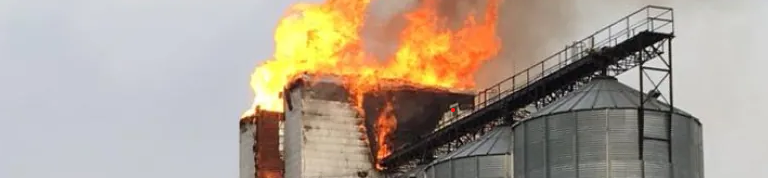
When a dust fire or explosion occurs, it can obviously lead not only to structural damage, but possible injury or death to anyone nearby. See an example of a dust explosion in this YouTube video showing a grain elevator explosion.

Classify All Confined Spaces with Potential for Airborne Dust Fires or Explosions as Permit-required Confined Spaces

So, consider the confined spaces present at your workplace, and take care to identify those with an actual or reasonable potential for a dense cloud of airborne combustible dust developing during entry operations, as those spaces will have to be classified as permit-required confined spaces.

Here are examples of some, but not all, types of confined spaces that, depending on materials they have contained, could produce heavy levels of airborne combustible dust during entry operations:

  • Conveyor systems
  • Cyclone separators
  • Duct work and air-handling systems
  • Dust collectors and bag houses
  • Grain storage bins, elevators, and silos
  • Hoppers and chutes
  • Mixers and blenders
  • Ovens and furnaces
  • Powder processing equipment such as mills and pulverizers
  • Truck and rail-car hoppers and tanks

In our next blog post (#11), we will examine the third criteria of a hazardous atmosphere that could be present inside of a confined space (oxygen deficiency or enrichment). In the meantime, please provide your feedback and questions to this blog post about airborne combustible dust at levels exceeding its lower flammable limit, or LFL, in the comments section below.

And as always, I hope you will take a moment to spread the word about our confined space training blog by share a link to this post with others in your network so they can benefit from this information.  Thanks – Curtis
Filed Under: Permit Required Confined Spaces Tagged With: combustible, confined space, dust, explosion, LFL, osha, permit

  • « Previous Page
  • 1
  • 2
  • 3
  • 4
  • 5
  • Next Page »

Recent Articles

Confined Space Training Requirements for Entry Supervisors

Confined Space Training Requirements for Entrants and Attendants

Is Confined Space Hazard Awareness Training Required for Non-Authorized Employees?

Requirements for Confined Space Entry Permits

OSHA Alternate Entry Procedures for Permit-required Confined Spaces

How to Reclassify a Permit Required Space to a Non-permit Space Through Hazard Isolation

Copyright © 2026 · Confined Space Training · All Rights Reserved · OSHA Training Services Inc. · 877-771-OSHA · SiteMap