Confined Space Entry Training

OSHA Confined Space Entry Training and Certification

  • ON-SITE Confined Space Entry Training Classes
    • Confined Space Training for General Industry
    • Confined Space Entry Training for Construction
  • ONLINE Confined Space Entry Training Courses
  • Confined Space Training Blog
  • Contact

Definition of a Hazardous Atmosphere – Flammable Gas, Vapor or Mist >10% LFL

February 24, 2023 by Curtis Chambers 6 Comments

Hazardous atmosphere flammable gas vapor or mist greater than 10% LFL or LEL

 Blog Post #9 – In previous blog posts, we discussed how to identify confined spaces, and provided several examples of such spaces. Next we will examine the factors that determine whether or not each confined space identified at your workplace must be classified as a permit-required confined space, starting with a hazardous atmosphere that contains a flammable gas, vapor, or mist in excess of 10% of its lower flammable limit, or LFL.

 OSHA Definition of a Permit-required Confined Space

The Federal OSHA definition of a permit-required confined space for general industry can be found in 1910.146, paragraph B, titled definitions, and in 1926.1202, also titled definitions, for the construction industry. That is where OSHA lists the four types of hazards that require a confined space be classified as a permit required confined space. Those four types of hazards are:

  • The space contains an actual or potential hazardous atmosphere;
  • The space contains a material with the potential to engulf the entrant;
  • The space is configured to trap or asphyxiate the entrant; or;
  • The space contains some other recognized serious safety or health hazard.

 What is a Hazardous Atmosphere?

 The Federal OSHA definition for “hazardous atmosphere”, the first classification listed above, is also found in 1910.146, paragraph B, definitions, for general industry, and in 1926.1202, definitions, for the construction industry.

There are five different types, or classifications, of hazardous atmospheres, listed in these two OSHA definitions. Those classifications, which are nearly identical in the two standards, are:

 (1) – Flammable gas, vapor, or mist in excess of 10 percent of its lower flammable limit (LFL);

 (2) – Airborne combustible dust at a concentration that meets or exceeds its LFL;

 (3) – Atmospheric oxygen concentration below 19.5 percent or above 23.5 percent;

 (4) – Atmospheric concentration of any substance for which a dose or a permissible exposure limit is published in subpart G, Occupational Health and Environmental Control, or in subpart Z, Toxic and Hazardous Substances, of this part and which could result in employee exposure in excess of its dose or permissible exposure limit;

 (5) – Any other atmospheric condition that is immediately dangerous to life or health.

 The balance of this particular blog post focuses on the first category of a hazardous atmosphere listed above, which is a flammable gas, vapor, or mist greater than 10% of its lower flammable

Greater Than 10 Percent Lower Flammable Limit (LFL)

 OSHA includes this type hazard because they do not want employers to wait until conditions are ripe for a flash fire or explosion to occur inside of a confined space before taking precautionary measures. Atmospheric conditions inside a confined space that contain a low level of flammable gas, vapor, or mist could quickly change for the worse. Therefore, OSHA regulations classify a flammable gas, mist, or vapor present inside a confined space at levels over 10% of its LFL as a hazardous atmosphere. Once that level is reached inside a confined space, or if there is a reasonable probability that it will develop within the space during entry operations, that space must be classified as a permit-required confined space.

 Lower Flammable Limit (LFL) Explained

 So, what is LFL? It stands for Lower Flammable Limit. The LFL is the minimum amount of a particular flammable gas, vapor, or mist that must be present in the atmosphere to ignite and burn. If you introduce an extremely small amount of a flammable gas, vapor, or mist into the atmosphere of a confined space, it might not ignite when exposed to an ignition source (such as a spark or flame) because there is not enough of the material present to form a flammable mixture in the air. How much flammable gas, vapor, or mist is needed in the atmosphere for a fire or explosion to occur? That depends on the gas, vapor, or mist present inside either space, as they all have a different LFL.

 What is LEL?

Be aware the term “LFL” is also referred to as “LEL”, or Lower Explosive Limit. The terms LFL and LEL are basically interchangeable. While OSHA uses LFL in their confined space standards, LEL is commonly used by many gas detection equipment manufacturers, as well as in many written confined space entry programs. Also, I may on occasion use the term LEL throughout future blog posts.

 LFLs of Common Flammable Gasses

The LELs of a few common combustible materials are listed in the chart below. An LEL is expressed as a percentage of the atmosphere within the confined space that is comprised of a particular combustible gas, vapor, or mist. For example, the LEL of Methane gas, with the chemical identifier of CH4, is 5% of the atmosphere at any given point. As you can see, the LELs of various gases differ quite a bit. 
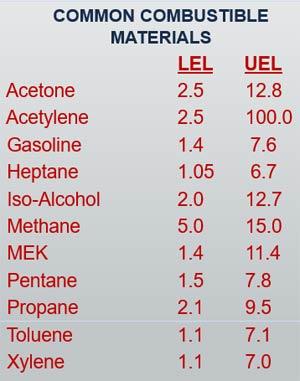
Upper and lower flammable limits of common gasses

What does UFL mean?

Note that each of the combustible materials listed in the chart also have their own UFL, or Upper Flammable Limit (expressed in the chart as an UEL). If a flammable gas, vapor, or mist is present in the atmosphere in quantities greater than its UFL, it will not ignite and burn. I bring up this term because while OSHA does not regulate UFLs, they do come into play when we discuss gas detection equipment in later blog posts.

Flammability Characteristics of Methane Gas

As mentioned earlier, the LFL of Methane gas is 5%. So, if Methane gas is present in a confined space, but it does not make up at least 5% of the atmosphere at any point within the space, there will be no flash fire or explosion if there is a spark or other source of ignition. And the upper flammable limit, or UFL, of Methane gas is 15%; So, a confined space containing higher levels of Methane would not burn or explode either. However, if the amount of Methane gas increases or decreases to fall somewhere between its LFL and UFL at any point inside a confined space and there is any source of ignition in that same area, a fire or explosion will occur.

Since Methane gas has an LFL of 5% of the atmosphere, a hazardous atmosphere as defined by OSHA would be present inside a confined space if the amount of Methane gas in the atmosphere exceeds 10% of that level. The presence of that level of Methane gas, which equates to just 0.5% of the total atmosphere, means the space would have to be classified as a permit-required confined space.

Other Hazards Associated with Methane Gas

Before moving on, let’s take a moment to discuss Methane gas, or CH4, a little more, as this is a hazardous gas commonly found in a variety of confined spaces. Methane is a colorless, tasteless gas that has no odor, so its presence cannot be detected by your senses alone. But too much Methane gas inside of a confined space creates not only a potentially flammable atmosphere, as previously discussed, it can also displace oxygen in the space, creating a deficiency of oxygen for an entrant to breathe. Fortunately, while Methane is a highly flammable gas that can also displace oxygen, it is one of the few flammable gases that is not toxic.

Where is Methane Gas Commonly Found?

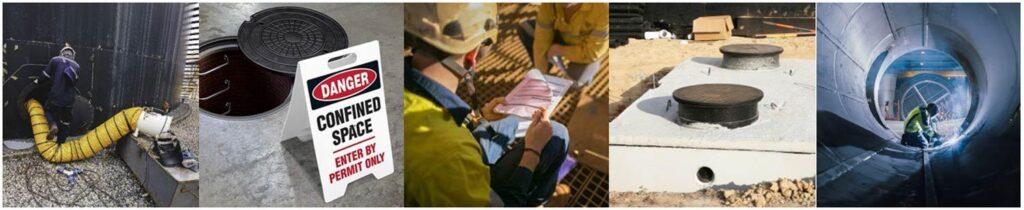
Methane is created when organic matter decomposes. Therefore, it is commonly found in potentially harmful quantities within confined spaces such as sewers and related facilities, manure pits, and in silos that have held grain or similar materials that has rotted. Methane is also commonly found in confined spaces such as underground utility vaults, especially those located near landfills (the rotting trash creates Methane). Therefore, these spaces are typically classified as permit-required confined spaces.

More Examples of Confined Spaces With Potentially Flammable Atmospheres

Other examples of confined spaces with a reasonable potential to contain an atmosphere containing a flammable gas, vapor, or mist above 10% of its LFL include pipelines, tanks and other vessels that have contained fuels or other flammable or combustible materials, even when they have been emptied of their contents. Also, confined spaces where work processes such as cutting with an oxy-acetylene torch or painting with flammable paints and solvents is taking place inside could potentially contain a hazardous atmosphere. And confined spaces such as vaults or tunnels in which there are leaking valves or piping used to transport flammable gas could also contain a hazardous atmosphere. As such, each of these spaces would also likely be classified as a permit-required confined space.

So, in review, any confined space with an actual flammable gas, vapor, or mist present at levels greater than 10 percent of its lower flammable limit, or LFL, is considered to have a hazardous atmosphere. And that means the space must be classified as a permit-required confined space. The same is true for any confined space in which that level of a flammable atmosphere could reasonably be expected to develop during entry operations. You may also hear the term LEL, which stands for lower explosive level, being used to describe a hazardous flammable atmosphere inside a confined space, as that term is synonymous with LFL.

In our next blog post (#10), we will examine the second criteria of a hazardous atmosphere that could be present inside of a confined space (combustible dust). In the meantime, please provide your feedback and questions to this blog post in the comments section below. And as always, I urge you to share a link to this confined space training blog post with anyone in your network who could benefit from this information. Thanks – Curtis
Filed Under: Permit Required Confined Spaces Tagged With: 1910.146, 1926 subpart AA, flammable atmosphere, hazardous atmosphere, LEL, LFL, lower explosive limit, lower flammable limit, methane gas, OSHA permit required confined space entry standard

Difference Between Permit Required Confined Spaces and Non-Permit Required Confined Spaces

January 26, 2023 by Curtis Chambers Leave a Comment

Difference between permit-required confined space and non-permit-required confined space

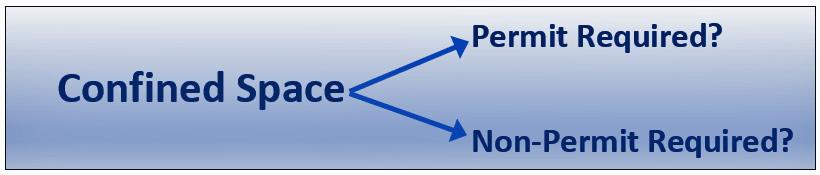
 Blog Post #8 – In this post to The Confined Space Training Blog, we will discuss the differences between a confined space that meets the Federal OSHA definition of a permit-required confined space versus one that can be classified as a non-permit required confined space.

Why make the distinction between permit and non-permit required confined spaces? Because entry into that space classified as a permit-required confined space is only allowed under an entry program meeting all pertinent requirements of the OSHA permit-required confined space entry standard. However, confined spaces that do not meet the OSHA definition of a permit space, which are called non-permit required confined spaces, may be entered without having to follow those additional precautions.

Criteria of a Permit-required Confined Space per the OSHA Definition

According to OSHA, a space is classified as a permit-required confined space if it meets one or more of the following characteristics:

  1. The space contains an actual or potential hazardous atmosphere;
  2. The space contains a material with the potential to engulf the entrant;
  3. The space is configured to trap or asphyxiate the entrant; or;
  4. The space contains some other recognized serious safety or health hazard.

We will break down each one of these four characteristics in subsequent blog posts. But for now, just be aware that it only takes one of these characteristics to be present, or reasonably expected to be present, for a confined space to be classified as a permit required confined space. Also, a permit-required confined space may contain two or more of these characteristics, and they all need to be identified so the hazards can be adequately addressed before entry operations begin.

What is a Non-permit Required Confined Space?

But what if the confined space does not meet any one of the four characteristics listed above? Then it could be classified as a non-permit space. According to the OSHA definitions in 1910.146 and in 1926 subpart AA, a non-permit required confined space is “a space that meets the definition of a confined space, but does not meet the requirements for a permit-required confined space, as outlined by the OSHA standard.”

When Re-evaluation of a Non-permit Space is Necessary

Keep in mind, however, that an employer must re-evaluate a non-permit required confined space if there are any changes to the use or configuration of that space that might increase the hazards to entrants, or if there is some indication that the initial evaluation of the space may not have been adequate. And if an actual or potential hazard is identified, the space must be reclassified as a permit-required confined space at that time.

For example, if a stainless-steel process tank is newly installed and has never held any material, and it has no agitators inside the tank or fill lines attached, it could be classified as a non-permit required confined space because it does not contain any health or safety hazards. However, if an employee needs to enter the tank to conduct an inspection and must decontaminate the inside of the tank before exiting by wiping it with isopropyl alcohol, which is flammable and toxic, the tank must be temporarily reclassified as a permit-required confined space during the performance of this task.

Reclassification of a Permit-required Confined Space to a Non-permit Confined Space

Last but not least, there are some opportunities where an employer who needs to enter into a permit-required confined space can implement steps to isolate the space from its hazards, allowing it to be temporarily reclassified as a non-permit confined space for as long as those hazards remain eliminated. More on that subject in a later blog post (#19).

Why it is Important to Properly Classify All Confined Spaces

Again, employers need to evaluate each confined space at their worksites to distinguish if it must be classified as a permit-required confined space, which requires implementation of a full permit-required confined space entry program, or if it can be classified as a non-permit required confined space. In the latter case, the space does not have to be identified with a warning sign, no permit is required to be filled out prior to entering the space, and no precautions listed in the OSHA permit-required confined space standards need be taken unless changes to the space or entry operations present an actual or potential hazard.

In our next blog post (#9), we will start examining what constitutes a hazardous atmosphere inside of a confined space. In the meantime, please provide your feedback and questions to this blog post in the comments section below. And as always, I urge you to share a link to this blog post with anyone in your network who could benefit from this information. Thanks – Curtis

Learn More About Confined Spaces

See Online Courses

Filed Under: Permit Required Confined Spaces Tagged With: 1910.146, 1926 subpart AA, non permit space, OSHA definition, permit required space, Reclassify confined space

Examples of Confined Spaces Per OSHA Definitions

December 31, 2022 by Curtis Chambers 30 Comments

Examples of confined spaces per OSHA definitions

Post #7 – In the previous post to the Confined Space Training Blog (#6), we examined the OSHA definition of a confined space, with in-depth explanations of the three criteria that make up a confined space per the definitions in the OSHA 1910 and 1926 confined space regulations. In this post, we will follow up by providing several examples of potential confined spaces you may find in the workplace; some expected, and some not.

Keep in mind that while these examples list below are but a few of the different types of confined spaces that could be present in the workplace, they may or may not be examples of permit-required confined spaces. We will discuss how to make that determination beginning in our next blog post.

Tanks, Bins, and Silos

Tanks of various types and sizes that are large enough to be bodily entered, and which are entered through a portal or other restricted opening on the bottom, side, or top, would be considered confined spaces. This includes many fuel tanks, water tanks, and even elevated water towers which are often entered vertically through a portal on top.

Silos that are large enough to be bodily entered through a man-way or hatch on the top, side, or bottom could be considered a confined space, as would be similarly constructed storage bins and hoppers.

Various types of tanks that are mounted on trailers are often considered confined spaces if they are large enough to be bodily entered and have a restricted means of entry or exit, as are many such tanks that are mounted directly onto a truck chassis. The same applies to similarly-configured tank rail cars that are pulled by locomotives and hopper cars of certain configurations. And concrete mixers would qualify as a mobile type confined space as well.

Industrial Equipment and Fixtures

Large furnaces and related equipment, which are constructed in certain configurations that make them hard to get into and out of, could also be considered confined spaces if they are large enough to be bodily entered by a worker. Some smokestacks and chimneys associated with furnaces, as well as incinerators and other burning processes, would be considered confined spaces if the worker must bodily enter them through a hatch, ladder, or other restricted means of entry.

Some pieces of fixed equipment, such as a large industrial mixing vat that can be bodily entered and has a restricted means of entry or exit, are considered confined spaces. In addition, many large boilers that are configured to be bodily entered through a restricted means of entry or exit are also considered confined spaces.

One commonly overlooked type of confined space is large air handlers, where the worker bodily enters through an access panel and climbs inside to perform work. Other examples of confined spaces include the associated ductwork if it is large enough for a worker to bodily enter through an access panel or hatch, or where the worker crawls through an open end to travel into the duct.

Conveyor tunnels that are large enough to be bodily entered and have a limited means of entry or exit would be considered a confined space, too. And don’t overlook trash or materials compactors, balers, and crushers that are configured as confined spaces.

Pits

Open-top pits that are deep enough to require the worker to enter or exit by a ladder or similar methods, or are too deep for the worker to easily step out of would be considered a confined space. And many escalator pits that are large enough for the worker to bodily enter, and that are deep enough that a worker would have difficulty getting in or out once the cover over the pit has been removed to facilitate entry, would also be considered confined spaces.

Many elevator shafts and pits are confined spaces that are deep enough or otherwise configured to require the worker to enter and exit on a ladder or via some other restricted means of entry or exit, are confined spaces.

Large dock levelers that are designed with a front cover or top that opens enough to allow a worker to crawl inside the pit beneath to perform maintenance or repairs on that equipment would be considered confined spaces.

Sewers, Vaults, and Other Underground Installations

Sanitary sewers which are large enough to be bodily entered qualify as confined spaces, as are many related facilities like sewer digesters, and some sewer lift stations.

Similarly, storm sewers that are large enough to be bodily entered and have a restricted means of entry or exit are considered confined spaces, as are many drainage culverts.

A related example of a confined space is a septic tank that is large enough for the worker to enter and has a restricted means of entry and exit. The same applies to many larger grease traps.

Most in-ground utility vaults that are entered via a hatch or manhole opening and that have not been designed for continuous occupancy are typically considered a confined space, as would be many wells.

Most pipelines, whether underground or not, are large enough to be bodily entered and have a restricted means of entry or exit, such as a portal, man-way, or an open-end small enough to require the worker to crawl or stoop to enter, qualify as a confined space. And even when a large bore pipeline has an open end and the worker can enter and exit upright, the pipeline would still be considered a confined space if the worker must travel a distance far enough to where they might not be able to get out in time should an emergency develop, thereby creating a restricted means of exit.

Tunnels and Crawl Spaces

Utility tunnels that have pipes, ducts or similar obstructions that require the entrant to crawl under or over them to exit the space could be considered a confined space, as would a long utility tunnel that requires the entrant to travel a great distance to get to the nearest means of egress.

Many crawl spaces located beneath buildings, floors, equipment, in between walls, and above some ceilings are also considered confined spaces.

Are Attics Confined Spaces?

If an attic space requires the worker to climb a ladder and squeeze through an opening to get inside it could be classified as a confined space.

Examples of Confined Spaces

These are but a few examples of confined spaces, and there are many others that were not mentioned here. If you take a few moments to think about it, you can probably come up with a list of all of the different types of confined spaces typically present at your workplace. And remember, it’s not just confined spaces that are part of the facilities, but also mobile confined spaces such as tanks transported by trucks and railcars, as well as confined spaces that are created during manufacturing or construction processes.

In our next post, we will begin exploring the criteria that determine whether or not each of these confined spaces (and others) must be categorized as a permit-required confined space, or if they are what OSHA calls a non-permit confined space.

Please add your comments to this post in the section provided. And please spread the word about our blog by sharing this post with others in your network. Thanks – Curtis

Filed Under: Permit Required Confined Spaces Tagged With: 1910, 1926, confined space definition, examples, osha

Understanding the OSHA Definition of a Confined Space

November 4, 2022 by Curtis Chambers 2 Comments

OSHA Confined Space Definition

Post #6 – Why is it paramount that you understand the OSHA confined space definition? Because OSHA regulates entry into permit-required confined spaces, and the only way to know if you have a permit-required confined space is to first understand whether or not you are even dealing with a confined space as defined by OSHA in their standards.

As you dig deeper into the OSHA confined space standards, you will come to realize that, in addition to the common question of what is the OSHA definition of a confined space, you will no doubt find yourself asking several other questions, such as:

  • What does OSHA mean by “bodily enter”?
  • Does a “limited or restricted means for entry or exit” mean there is only one way in and out of the confined space? and,
  • If there are no hazards present in the space, does that mean it does not meet the definition of a confined space?

Answers to these questions and more are forthcoming in this blog post.

OSHA’s Confined Space Definitions

The OSHA definition of a confined space appears in both the 1910.146 confined space standards for general industry (see section (b) – definitions), as well as in the 1926 Subpart AA confined space standards for construction (see 1926.1202 – definitions). These two definitions are essentially the same, so we will focus on the definition of a confined space found in the general industry rules for now.

According to the OSHA definition of a confined space found in 1910.146(b), a confined space is characterized by three distinct criteria. The standard states that a confined space is a space that:

(1) Is large enough and so configured that an employee can bodily enter and perform assigned work; and,

(2) Has limited or restricted means for entry or exit (for example, tanks, vessels, silos, storage bins, hoppers, vaults, and pits are spaces that may have limited means of entry.); and,

(3) Is not designed for continuous employee occupancy.

Be mindful that all three of these criteria must be in place to meet the OSHA definition of a confined space.  Also, keep in mind that whether or not a hazard is present inside the space is not relevant at this point. You are only trying to determine whether or not you have a confined space at your work site.

The Meaning of “Bodily Enter”

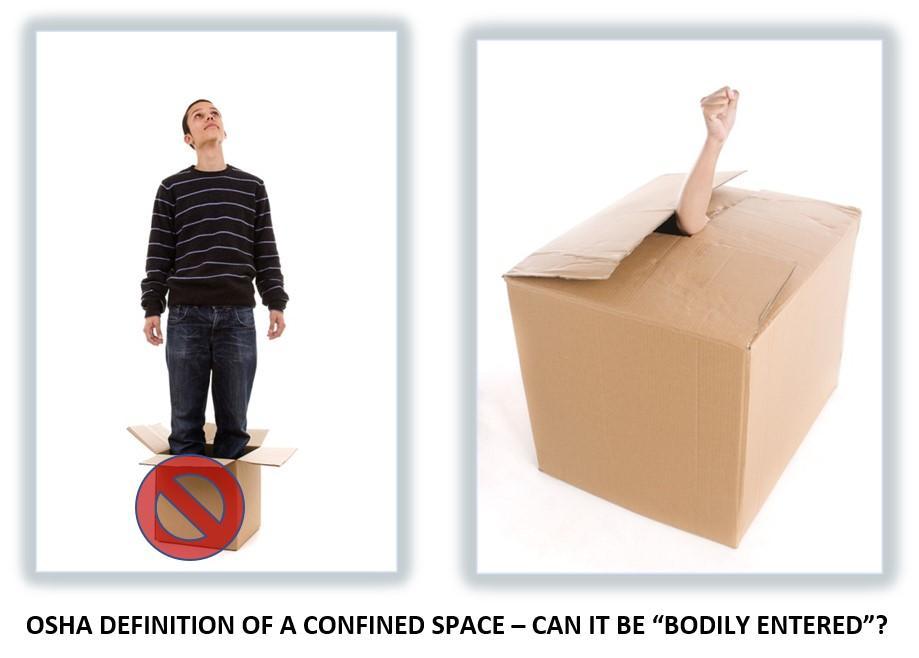
The first criteria listed in OSHA’s definition of a confined space is that the space is large enough and so configured that an employee can bodily enter and perform assigned work. The operative term here is “bodily enter”, which, unfortunately, OSHA does not define in their standards. However, OSHA clarifies on page 4477 of the preamble to the final rule for the 1910.146 confined space standards [Federal Register / Vol. 58, No. 9 / Thursday, January 14, 1993] that the term “bodily enter” means the employee can fit entirely inside the space, and that their confined space rule was intended to cover only spaces that are large enough for the entire body of an employee to enter.

So, to reiterate, if the space is not large enough or configured to where it can be bodily entered, or in other words, if the employee cannot get their entire body inside of the space, then it does not meet the OSHA definition of a confined space. And the OSHA confined space entry standards are only intended to apply to spaces large enough and configured so that the entire body of an employee can fit inside the space.

What is meant by bodily enter in OSHA confined space standard

That being said, don’t buy into the false assumption that entry into a confined space begins only after a person gets their entire body inside of the space, because that is not the case. The OSHA definition of “entry” states that entry is considered to have occurred as soon as any part of the entrant’s body breaks the plane of an opening into the confined space. So, if your space meets the definition of a confined space that can be bodily entered (which means the employee being able to fit their entire body into the space), entry into that confined space is considered to have occurred as soon as any part of their body crosses any plane of entry into that space. Conversely, if the space cannot be bodily entered, then it is not a confined space, regardless of whether or not a worker is able to stick some part of their body into the space.

One final word of caution regarding this topic; don’t think that just because a space cannot be bodily entered and is therefore not covered by the confined space entry standards, that it is exempt from all other OSHA safety or health regulations. For example, we now know that a tank with an entry portal that is too small for a person to bodily enter is not a confined space. However, if the portal is still large enough for a person to stick their head inside, and the tank contains a deadly atmosphere, they could be seriously injured, or perhaps even die; they just wouldn’t have died inside of a confined space. In the case of this particular tank, there are other OSHA regulations pertaining to respiratory protection that would apply to protect the worker who sticks their head inside the tank; those rules just wouldn’t be part of the OSHA confined space entry standards.

OSHA Definition: “Limited or Restricted Means for Entry or Exit”

The second criteria listed in OSHA’s definition of a confined space is that the space has limited or restricted means for entry or exit. There is no definition for this term in the OSHA 1910 permit-required confined space entry standard. Therefore, many people believe the term means that there is only one way in and out of the space. But that is not correct; a confined space may have one entry point, or it may have a dozen.

The OSHA confined space advisor clarifies OSHA’s intent by explaining that a limited or restricted means for entry or exit exist where the occupant must crawl, climb, twist, be constrained in a narrow opening, follow a lengthy path, or otherwise exert unusual effort to enter or leave, or where the entrance may become sealed or secured against opening from inside. Also, the newer 1926 confined spaces in construction standard does include a definition for the term “limited or restricted means of entry or exit” in 1926.1202. That definition states it means “a condition that has a potential to impede an employee’s movement into or out of a confined space”. The definition goes on to explain that examples of a limited means of entry or exit include, but are not limited to, trip hazards, poor illumination, slippery floors, inclining surfaces, and ladders, all conditions which could make it difficult to escape the space should an emergency arise.

Based on the previous information, here is a non-exhaustive list of examples of conditions where a limited or restricted means for entry or exit could exist:

  • Portals where the entrant must squeeze through to enter or exit the space horizontally, as well as where entry is made vertically;
  • Hatches of a size or location requiring the entrant to climb or squeeze through;
  • Manholes that the entrant must pass through an opening to get into or out of the space;
  • A pipeline of a size that requires the worker to crawl to get through the pipe;
  • Spaces such as open top pits or attics where the worker must climb up or down on a ladder to enter or exit the space;
  • Spiral staircases, which can be difficult to climb or descend, which are used to access a space;
  • Steep stairways, such as ships ladders and other non-standard stairways, used to access a space;
  • Tight crawlspaces, such as beneath equipment, under floors, between walls, and above some ceilings; and;
  • An underground utility tunnel where the worker must travel a long distance to get to the nearest exit point.

Is a Door Considered a Limited Means of Entry or Exit?

The question often arises as to whether or not OSHA considers a standard size doorway to be a limited or restricted means of entry or exit. This topic is not specifically addressed in the OSHA 1910 permit required confined space entry standard.  However, In the preamble to the 1910 general industry permit-required confined space standard, OSHA states that “doorways and other portals through which a person can walk are not to be considered a limited means of entry or exit.” However, the preamble goes on to explain that a space containing such a door or portal may still be deemed a confined space if an entrant’s ability to escape from inside the space in an emergency would be hindered.

OSHA further clarifies their position about doorways in a later amendment to the 1910 standard published in the Federal Register, where they state that “even if the door or portal of a space is of sufficient size, obstructions could make entry into or exit from the space difficult. The Agency intended that spaces which otherwise meet the definition of confined spaces, and which have obstructed entry or exits even though the portal is a standard size doorway, be classified as confined spaces.” In other words, a space with a standard doorway (which is a doorway at least two feet wide and at least six and one-half feet in height, according to OSHA’s FAQs page for their confined spaces in construction standard) would be considered to have a limited means of entry or exit if, inside that space, there are pipes, duct work, equipment, or other obstructions or obstacles that would make it difficult for a worker to access the door to escape in the case of an emergency, or if the door could lock and trap the person inside the space.

One more thing to keep in mind at some manufacturing and construction environments is that a large structure being constructed may not have a limited means of entry or exit – at least not initially.

But it may become a confined space with a limited means of entry or exit at a later point during the fabrication or construction process.  For example, an employee can easily walk into and out of a large diameter, horizontally-oriented steel vessel being fabricated if one or both ends are wide open, because no restricted entry or exit exists at that particular point in time. However, once the ends of the vessel are installed and employees must enter and exit the vessel through a portal or similar small opening, a limited means of entry and exit would then exist.

Third Criteria for the OSHA Definition of a Confined Space: Not Designed for Continuous Employee Occupancy

 The third and final criteria listed in OSHA’s definition of a confined space is that the space is not designed for continuous employee occupancy. For example, most underground utility vaults are not designed and outfitted with any safeguards to control a potentially hazardous atmosphere, nor are most underground vaults outfitted with an adequate light source. So, at a minimum, workers would most likely have to utilize a portable blower, auxiliary lighting, and a portable gas detector to safely enter and work inside such vaults.

 On the other hand, there are some underground utility vaults that has been engineered and constructed with a built-in ventilation system, lighting system, and gas detection system to maintain a safe atmosphere. Because such a vault has been designed by engineers for employees to enter and work without the need to implement any safeguards during the duration of their time inside the space, this particular utility vault would not meet this third criteria of the OSHA definition of a confined space, and therefore would not be considered a confined space.

Recap of the Three Criteria of the OSHA Confined Space Definition

 So, in review, here is a recap of the three criteria listed in OSHA’s definition of a confined space:

 Number 1 – the space is large enough and so configured that an employee can bodily enter and perform assigned work (that means the worker can get their entire body inside of the space);

Number 2 – the space has limited or restricted means for entry or exit (that means it would be hard to get into or out of in case of an emergency); and,

Number 3 – the space has not been designed for continuous employee occupancy.

 As a reminder, all three of the criteria listed above must be present for the space to meet the OSHA definition of a confined space. Also, remember that all confined spaces are not necessarily permit-required confined spaces; that is to be determined later.

In our next blog post (#7), we will provide numerous examples of confined spaces, including a few that you might not have thought about. Then, beginning with post #8, we will take a very deep dive into how to determine whether or not the spaces meeting OSHA’s definition of a confined space are to be subsequently classified as permit-required confined spaces, or non-permit confined spaces.

 Final Note: Do you find our confined space entry training blog to be helpful? If so, please send a link to our blog to others in your network who could benefit from this kind of information. Thanks, Curtis


Learn How to Identify Confined Spaces

Online Course - How to Identify Confined Spaces for General Industry
Online Course - How to Identify Confined Spaces at Construction Sites

Filed Under: Permit Required Confined Spaces Tagged With: bodily enter, confined space definition, employee occupancy, limited means of entry or exit, three criteria

OSHA Requirement for a Competent Person to Identify Permit Required Confined Spaces

October 21, 2022 by Curtis Chambers Leave a Comment

Confined Space Competent Person

Post #5 – The success of an organization’s confined space entry program is ultimately predicated on having a competent person with the ability to identify and evaluate the confined spaces at their work sites to determine whether or not they meet the OSHA definition of a permit-required confined space. And that takes a person with sufficient training and experience to do the job right. But exactly whose job is it to identify and evaluate confined spaces?

Here’s what the OSHA confined space regulations say about that.

OSHA Requirements to Evaluate Confined Spaces

The first paragraphs from the general requirements sections of the OSHA confined space entry standards for general industry and construction, respectively, are listed below:

GENERAL INDUSTRY

1910.146(c)(1) – The employer shall evaluate the workplace to determine if any spaces are permit-required confined spaces.

CONSTRUCTION

1926.1203(a) – Before it begins work at a worksite, each employer must ensure that a competent person identifies all confined spaces in which one or more of the employees it directs may work, and identifies each space that is a permit space, through consideration and evaluation of the elements of that space, including testing as necessary.

As you see, both of these performance-based confined space standards place the onus on employers, either individually or through a designated Competent Person, to evaluate their workplaces to determine if any confined spaces are present. Then, they must determine if any of those confined spaces are to be categorized as a permit required confined space, or alternatively, as a non-permit-required confined space.

Special Qualifications or Certifications Needed to  Evaluate Confined Spaces?

While OSHA requires employers to ensure the confined spaces at their worksites are identified and evaluated, their standards do NOT require the completion of any specific training class or “competent person certification” for confined spaces for the person conducting the evaluations. Instead, an OSHA compliance officer would simply speak with whomever the employer has appointed as their competent person to perform the confined space evaluations, and determine if they seem to have adequate experience, training certification, and knowledge needed to do the job competently.

Duties of the Competent Person Evaluating Confined Spaces

The competent person who is designated to evaluate the confined spaces at a worksite to determine whether or not they are permit spaces must be capable of effectively performing the following three tasks for the worksite in question:

  • Identify all confined spaces at the worksite after consideration of all facets of the OSHA definition of a confined space;
  • Determine if each confined space identified at the site will be categorized as a permit-required confined space, or as a non-permit confined space;
  • When conditions demand, re-evaluate (and possible reclassify) a non-permit confined space, should the configuration of that space change in a manner that could cause it to become a permit-required confined space (especially true during progression of the construction process when building a confined space such as a tank). Re-evaluation of a non-permit required confined space must also be performed every time there is a work process or activity taking place inside of, or near, any non-permit confined space which could potentially introduce new hazards that require the non-permit space be reclassified as a permit-required confined space.

In many cases, an employer also will have the person designated as their competent person for confined space identification to serve as the entry supervisor for their confined space entry crew. However, doing so is not a strict requirement of the confined space standards, as those two roles could be filled by different personnel.

OSHA Documentation Requirements for Confined Space Evaluations

In case you were wondering, there is no requirement in the federal OSHA confined space entry standards requiring the employer to document their confined space evaluations; however, some employers may choose to do so anyway.

Identifying Permit-Required Confined Spaces at Multi-employer Worksites

OSHA gives employers working at a multi-employer job-site such as but not limited to construction sites the option to collaborate on identifying permit spaces at a worksite, by agreeing to use one designated competent person to perform the initial surveys. Or they can choose to use their own designated competent person to perform the surveys. But either way, each employer who has an employee who will enter into a confined space is ultimately responsible for compliance with the requirements of the OSHA confined space entry standards, and must therefore utilize due diligent before deciding to count on another employer’s competent person to perform the evaluations.

Designation of a Person Competent to Identify Permit-required Confined Spaces

Obviously, the wide variety in types of confined spaces and the assortment of potential hazards inside of those spaces will vary greatly from site to site. So, a competent person with training and experience in dealing with only one specific type of confined space may be capable of evaluating the spaces in a worksite if it only contains the same types of spaces with which they are already familiar. But that same person may or may not be suitable for evaluating the confined spaces of a type they have not experienced before. Only the employer can decide, based upon his or her knowledge of, and experience with permit required confined spaces, who is adequately prepared and able to be designated as being their competent person responsible for identifying permit-required confined spaces at the workplace.

Coming up in the next blog post (#6); we will start a deep dive into understanding the OSHA definition of a confined space.

Final Note: Thanks for reading the blog. Please help spread the word about our confined space entry training blog by sending a link to the blog to others in your network who could benefit from this information. Thanks – Curtis
Filed Under: Permit Required Confined Spaces Tagged With: 1910.146, 1926 subpart AA, competent person, evaluation, identify, non permit, OSHA permit required confined space entry standard, OSHA requirements

  • « Previous Page
  • 1
  • 2
  • 3
  • 4
  • 5
  • Next Page »

Recent Articles

Confined Space Training Requirements for Entry Supervisors

Confined Space Training Requirements for Entrants and Attendants

Is Confined Space Hazard Awareness Training Required for Non-Authorized Employees?

Requirements for Confined Space Entry Permits

OSHA Alternate Entry Procedures for Permit-required Confined Spaces

How to Reclassify a Permit Required Space to a Non-permit Space Through Hazard Isolation

Copyright © 2026 · Confined Space Training · All Rights Reserved · OSHA Training Services Inc. · 877-771-OSHA · SiteMap